 |
AutoAPMS
Streamlining behaviors in ROS 2
|
|
AutoAPMS
Streamlining behaviors in ROS 2
|
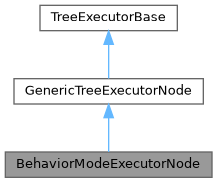
ROS 2 component that hosts a BehaviorModeExecutor and its owned mode on an in-process behavior tree executor node. More...
#include <auto_apms_px4/behavior_mode_executor.hpp>
Additional Inherited Members | |
 Public Types inherited from TreeExecutorBase Public Types inherited from TreeExecutorBase | |
| enum class | ExecutionState : uint8_t { IDLE , STARTING , RUNNING , PAUSED , HALTED } |
| Enum representing possible behavior tree execution states. More... | |
| enum class | ControlCommand : uint8_t { RUN , PAUSE , HALT , TERMINATE } |
| Enum representing possible commands for controlling the behavior tree execution routine. More... | |
| enum class | TreeExitBehavior : uint8_t { TERMINATE , RESTART } |
| Enum representing possible options for what to do when a behavior tree is completed. More... | |
| enum class | ExecutionResult : uint8_t { TREE_SUCCEEDED , TREE_FAILED , TERMINATED_PREMATURELY , ERROR } |
| Enum representing possible behavior tree execution results. More... | |
| Public Member Functions inherited from GenericTreeExecutorNode | |
| GenericTreeExecutorNode (rclcpp::Node::SharedPtr node_ptr, Options options) | |
| Constructor using an existing ROS 2 node. | |
| GenericTreeExecutorNode (const std::string &name, Options options) | |
| Constructor which creates a new ROS 2 node. | |
| GenericTreeExecutorNode (const std::string &name) | |
| Constructor with default executor options. | |
| std::shared_future< ExecutionResult > | startExecution (const std::string &build_request, const std::string &entry_point="", const core::NodeManifest &node_manifest={}) |
| Start the behavior tree specified by a particular build request. | |
| ExecutorParameters | getExecutorParameters () const |
| Get a copy of the current executor parameters. | |
| std::map< std::string, rclcpp::ParameterValue > | getParameterValuesWithPrefix (const std::string &prefix) |
| Assemble all parameters of this node that have a specific prefix. | |
| bool | updateScriptingEnumsWithParameterValues (const std::map< std::string, rclcpp::ParameterValue > &value_map, bool simulate=false) |
| Update the internal buffer of scripting enums. | |
| bool | updateGlobalBlackboardWithParameterValues (const std::map< std::string, rclcpp::ParameterValue > &value_map, bool simulate=false) |
| Update the global blackboard using parameter values. | |
| void | loadBuildHandler (const std::string &name) |
| Load a particular behavior tree build handler plugin. | |
| TreeConstructor | makeTreeConstructor (const std::string &build_request, const std::string &entry_point="", const core::NodeManifest &node_manifest={}) |
| Create a callback that builds a behavior tree according to a specific request. | |
| core::TreeBuilder::SharedPtr | createTreeBuilder () |
| Create a tree builder for building the behavior tree. | |
| virtual bool | clearGlobalBlackboard () override |
| Reset the global blackboard and clear all entries. | |
| std::shared_future< ExecutionResult > | startExecution (TreeConstructor make_tree, double tick_rate_sec=0.1, int groot2_port=-1) |
| Start a behavior tree that is built using a callback. | |
| template<typename TimeRepT = int64_t, typename TimeT = std::milli> | |
| std::shared_future< ExecutionResult > | startExecution (TreeConstructor make_tree, const std::chrono::duration< TimeRepT, TimeT > &tick_rate, int groot2_port=-1) |
| Start a behavior tree that is built using a callback. | |
| std::shared_future< ExecutionResult > | startExecution (std::unique_ptr< Tree > tree, double tick_rate_sec=0.1, int groot2_port=-1) |
| Start executing a behavior tree that has already been created. | |
| template<typename TimeRepT = int64_t, typename TimeT = std::milli> | |
| std::shared_future< ExecutionResult > | startExecution (std::unique_ptr< Tree > tree, const std::chrono::duration< TimeRepT, TimeT > &tick_rate, int groot2_port=-1) |
| Start executing a behavior tree that has already been created. | |
| Public Member Functions inherited from TreeExecutorBase | |
| TreeExecutorBase (rclcpp::Node::SharedPtr node_ptr, rclcpp::CallbackGroup::SharedPtr tree_node_callback_group_ptr=nullptr) | |
| Constructor. | |
| std::shared_future< ExecutionResult > | startExecution (TreeConstructor make_tree, double tick_rate_sec=0.1, int groot2_port=-1) |
| Start a behavior tree that is built using a callback. | |
| template<typename TimeRepT = int64_t, typename TimeT = std::milli> | |
| std::shared_future< ExecutionResult > | startExecution (TreeConstructor make_tree, const std::chrono::duration< TimeRepT, TimeT > &tick_rate, int groot2_port=-1) |
| Start a behavior tree that is built using a callback. | |
| std::shared_future< ExecutionResult > | startExecution (std::unique_ptr< Tree > tree, double tick_rate_sec=0.1, int groot2_port=-1) |
| Start executing a behavior tree that has already been created. | |
| template<typename TimeRepT = int64_t, typename TimeT = std::milli> | |
| std::shared_future< ExecutionResult > | startExecution (std::unique_ptr< Tree > tree, const std::chrono::duration< TimeRepT, TimeT > &tick_rate, int groot2_port=-1) |
| Start executing a behavior tree that has already been created. | |
| void | setControlCommand (ControlCommand cmd) |
| Set the command that handles the control flow of the execution routine. | |
| bool | isBusy () |
| Determine whether this executor is currently executing a behavior tree. | |
| ExecutionState | getExecutionState () |
| Get a status code indicating the current state of execution. | |
| std::string | getTreeName () |
| Get the name of the tree that is currently executing. | |
| TreeBlackboardSharedPtr | getGlobalBlackboardPtr () |
| Get a shared pointer to the global blackboard instance. | |
| TreeStateObserver & | getStateObserver () |
| Get a reference to the current behavior tree state observer. | |
| rclcpp::Node::SharedPtr | getNodePtr () |
| Get a shared pointer to the parent ROS 2 node. | |
| rclcpp::node_interfaces::NodeBaseInterface::SharedPtr | get_node_base_interface () |
| Get the node's base interface. Is required to be able to register derived classes as ROS2 components. | |
| rclcpp::CallbackGroup::SharedPtr | getTreeNodeWaitablesCallbackGroupPtr () |
| Get the callback group used for all waitables registered by behavior tree nodes. | |
| rclcpp::executors::SingleThreadedExecutor::SharedPtr | getTreeNodeWaitablesExecutorPtr () |
| Get the ROS 2 executor instance used for spinning waitables registered by behavior tree nodes. | |
| Static Public Member Functions inherited from GenericTreeExecutorNode | |
| static std::string | stripPrefixFromParameterName (const std::string &prefix, const std::string ¶m_name) |
| Get the name of a parameter without its prefix. | |
| Static Public Attributes inherited from GenericTreeExecutorNode | |
| static const std::string | PARAM_VALUE_NO_BUILD_HANDLER = "none" |
| Value indicating that no build handler is loaded. | |
| Protected Member Functions inherited from GenericTreeExecutorNode | |
| virtual void | preBuild (core::TreeBuilder &builder, const std::string &build_request, const std::string &entry_point, const core::NodeManifest &node_manifest, TreeBlackboard &bb) |
| Callback invoked before building the behavior tree. | |
| virtual void | postBuild (Tree &tree) |
| Callback invoked after the behavior tree has been instantiated. | |
| Protected Attributes inherited from TreeExecutorBase | |
| rclcpp::Node::SharedPtr | node_ptr_ |
| Shared pointer to the parent ROS 2 node. | |
| const rclcpp::Logger | logger_ |
| Logger associated with the parent ROS 2 node. | |
ROS 2 component that hosts a BehaviorModeExecutor and its owned mode on an in-process behavior tree executor node.
Configuration is entirely parameter driven. Registration-time parameters are read once here in the constructor and are declared read only; the remaining parameters are dynamic and re-read on each activation, so they can be changed at runtime (e.g. via ros2 param set) and take effect the next time the executor is put in charge:
activation (string, read only): armed, always or immediately (see px4_ros2::ModeExecutorBase::Settings::Activation). Latched at mode registration.mode_name (string, read only): Registered name of the owned PX4 mode. Latched at mode registration.on_completion / on_failure (string, dynamic): Reaction after the behavior succeeds/fails (hold, rtl, land, disarm, complete, none).defer_failsafes (bool, dynamic): Defer FMU failsafes while a behavior is running.behavior.build_request / behavior.entry_point / behavior.node_manifest (dynamic): Which behavior to run.build_handler (string), tick_rate (double), groot2_port (int): Standard behavior tree executor parameters consumed via inherited GenericTreeExecutorNode.This node disables GenericTreeExecutorNode's strict unkown parameter removal via TreeExecutorNodeOptions so these behavior-specific parameters can coexist on the same node.
Registration with the FMU (a blocking operation) happens in the constructor and is delegated to a ModeRegistrationHandler. Unlike a plain mode registered via ModeRegistrationFactory, the owned mode is not announced on the registered_modes topic: a mode executor cannot be put in charge by another mode executor, so it is not a target for SendCmdSetNavState-based orchestration from a behavior tree. Mode executors instead serve as a mechanism to trigger automation from PX4 itself (RC switch, GCS, ActivateImmediately); native ROS 2 orchestration should activate modes directly.
Definition at line 211 of file behavior_mode_executor.hpp.
 1.13.2