 |
AutoAPMS
Streamlining behaviors in ROS 2
|
|
AutoAPMS
Streamlining behaviors in ROS 2
|
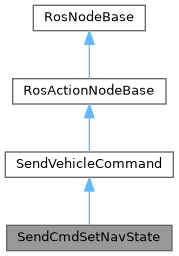
Behavior tree node that switches the active PX4 flight mode while respecting mode-executor ownership. More...
Additional Inherited Members | |
 Protected Member Functions inherited from SendVehicleCommand Protected Member Functions inherited from SendVehicleCommand | |
| uint16_t | resolveSourceComponent () |
| Transitively resolve the in-charge mode executor's source component from the global blackboard. | |
| Protected Member Functions inherited from RosNodeBase | |
| void | applyPortAliasing (const BT::TreeNode *node) const |
| Support the node manifest 'port_alias' feature: copy the aliased port values onto the original ports the node implementation reads. | |
| template<typename InstanceT> | |
| std::shared_ptr< InstanceT > | getSharedEntity (const std::string &entity_name, const std::function< std::shared_ptr< InstanceT >()> &factory) |
Retrieve a process-wide shared ROS 2 entity, creating it via factory on first use. | |
Behavior tree node that switches the active PX4 flight mode while respecting mode-executor ownership.
A specialization of SendVehicleCommand that fixes the command to VEHICLE_CMD_SET_NAV_STATE and exposes the target navigation state through a single, friendly nav_state input port instead of the raw command parameters.
As with any SendVehicleCommand, the command's source_component is resolved from the global blackboard so that an in-charge auto_apms_px4::BehaviorModeExecutor can attribute the mode change to itself. If no executor is in charge, the command is sent with the default source component (0).
Definition at line 39 of file send_cmd_set_nav_state.cpp.
 1.13.2