 |
AutoAPMS
Streamlining behaviors in ROS 2
|
|
AutoAPMS
Streamlining behaviors in ROS 2
|
Sends the 'configure' transition (id=1) to a lifecycle node. More...
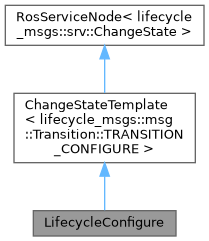
Additional Inherited Members | |
 Public Member Functions inherited from RosServiceNode< lifecycle_msgs::srv::ChangeState > Public Member Functions inherited from RosServiceNode< lifecycle_msgs::srv::ChangeState > | |
| RosServiceNode (const std::string &instance_name, const Config &config, Context context) | |
| Constructor. | |
| virtual BT::NodeStatus | onResponseReceived (const typename Response::SharedPtr &response) |
| Callback invoked after the service response was received. | |
| virtual BT::NodeStatus | onFailure (ServiceNodeErrorCode error) |
| Callback invoked when one of the errors in ServiceNodeErrorCode occur. | |
| bool | createClient (const std::string &service_name) |
| Create the client of the ROS 2 service. | |
| std::string | getServiceName () const |
| Get the name of the service this node connects with. | |
| Static Public Member Functions inherited from RosServiceNode< lifecycle_msgs::srv::ChangeState > | |
| static BT::PortsList | providedBasicPorts (BT::PortsList addition) |
| ADerived nodes implementing the static method RosServiceNode::providedPorts may call this method to also include the default port for ROS 2 behavior tree nodes. | |
| static BT::PortsList | providedPorts () |
| If a behavior tree requires input/output data ports, the developer must define this method accordingly. | |
| Protected Member Functions inherited from RosNodeBase | |
| void | applyPortAliasing (const BT::TreeNode *node) const |
| Support the node manifest 'port_alias' feature: copy the aliased port values onto the original ports the node implementation reads. | |
| template<typename InstanceT> | |
| std::shared_ptr< InstanceT > | getSharedEntity (const std::string &entity_name, const std::function< std::shared_ptr< InstanceT >()> &factory) |
Retrieve a process-wide shared ROS 2 entity, creating it via factory on first use. | |
Sends the 'configure' transition (id=1) to a lifecycle node.
Definition at line 165 of file lifecycle_nodes.cpp.
 1.13.2